
AI Slop is Not an AI Problem
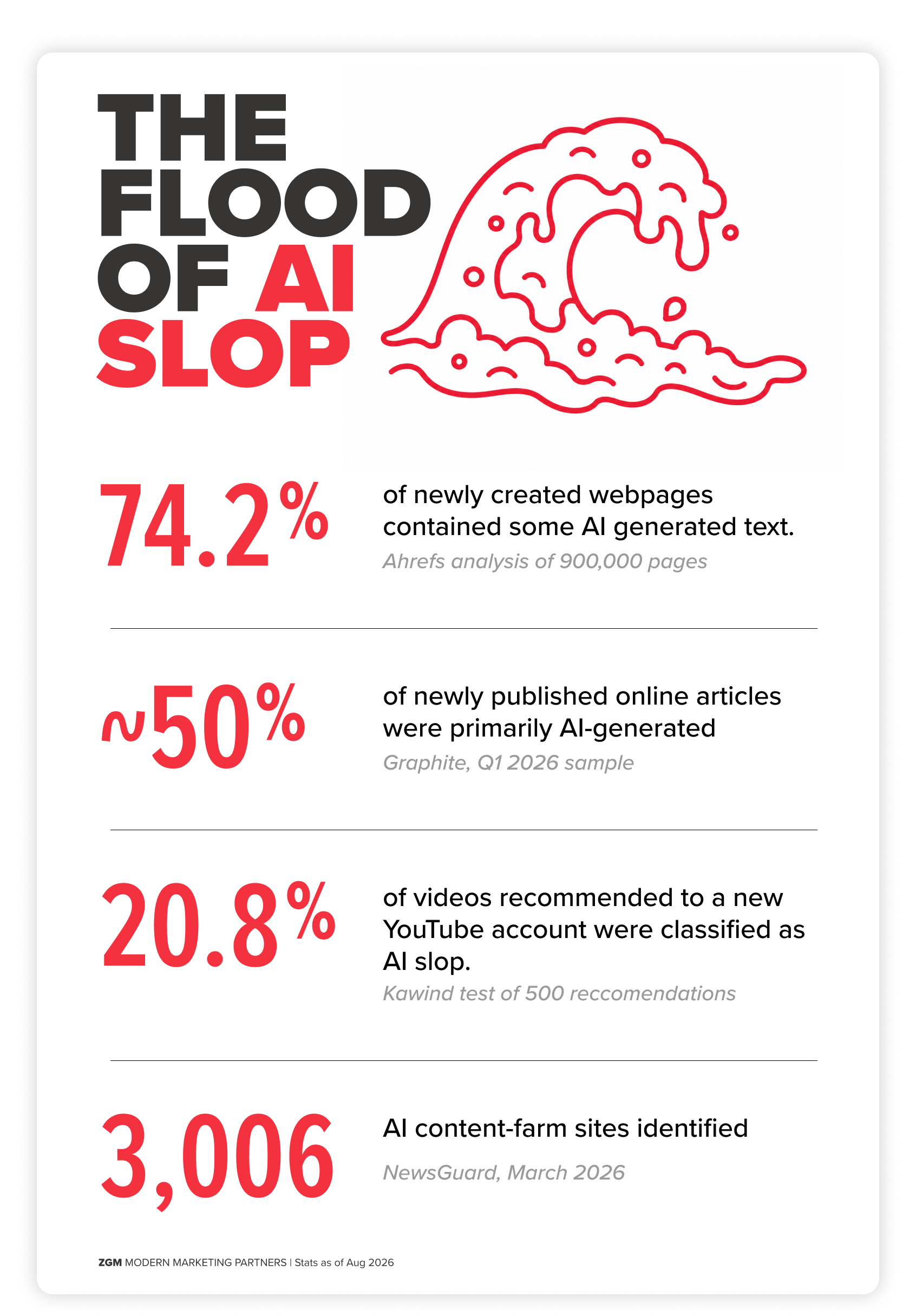
The flood of low-quality AI content feels unprecedented, but it’s not the first time we've encountered this. According to Ahrefs, in April 2025, over 74% of new web pages contained some AI-generated text. This explosive adoption of a new tool always creates a temporary wave of junk, and an opportunity for quality to stand out.
Key takeaways
The term “AI slop” refers to low-effort, mass-produced content mostly made to game algorithms.
AI is now involved in most new web content; as of Q1 2026, about half of all new articles online were primarily AI-generated.
The world has seen many examples of content slop, which eventually gave way to better design standards.
Our constant bombardment of content in social is a bigger issue than content creation itself, as they can disproportionately amplify low-quality slop.
We've been here before. Sort of.
This isn't the first time this has happened. Only the scale's different.
Want a few examples?
Early radio (1920s–1930s): amateurish, filler programming
Radio in the 1920s had no money, no formats, and no idea what it was doing. Stations filled airtime with borrowed phonograph records, volunteer singers, and whatever they could scrape together. Over 60% was just music because music was easy, and the goal wasn't quality, it was simply not having dead air. Feels familiar?
Early television (1940s–1950s): from live drama to formulaic shows
What gets left out of Television's Golden Age is what happened after the hype died down: demand went up, production moved to Los Angeles, and the whole thing shifted toward pre-recorded, cheaper, more formulaic shows. Sitcoms, westerns, quiz shows, the kind of programming you make when you need to fill a schedule. Similar pattern as before: new medium, huge appetite, a flash of quality work at the start, then volume.
Every time a powerful new creative tool becomes widely accessible, we get a tidal wave of trash. It’s the unavoidable byproduct of putting power in more hands.
Remember Flash Websites (1996-2005)? (you probably don’t)
For those of us who were building for the web in the late 90s and early 2000s, the current panic feels familiar. When Macromedia Flash (later Adobe Flash) put animation and interactivity tools in the hands of millions, the internet got ugly. Fast. We were flooded with websites that had long, unskippable intro animations, overly clever (and sometimes animated) navigations where you had to guess what to click, and sound effects that would blast out of your speakers without warning.
It was a mess, AKA: slop.
There's more examples than I care to put in a blog such as the printing press, dime novels, email spam and digital cameras. Each time the methods get more available and cheaper, the content goes up, and usually not in a good way.
How Much AI Content Is Out There?
AI contributes to most newly created web pages and may account for almost half of all new online articles. An Ahrefs study of 900,000 new pages published in April 2025 found that 74.2% contained at least some AI-generated text. However, the study also found that only 2.5% of pages were written entirely by AI, indicating most usage is a human/AI hybrid.
The truly low-quality “slop” is a smaller portion of all AI-generated content, but it is produced at an industrial scale.
Primary authorship is 50/50. According to Graphite’s analysis of over 55,000 URLs from the Common Crawl dataset, 49.9% of newly published web articles in Q1 2026 were primarily AI-generated. That figure was briefly higher, at 50.9%, in the final quarter of 2025.
“AI-generated” and “slop” are distinct terms. A carefully edited article drafted with AI assistance or a page translated by a neural network can be useful. Scientific American describes “slop” as the cheap, mass-produced filler that appears whenever a new medium lowers production costs.
Amplification Is the Core Problem
The amplification of AI slop is the core issue. Engagement-driven algorithms on major platforms are funnelling this content directly to users. Even if slop is a minority of all content on the internet, it can become a majority of what people actually see.
YouTube is a prime example. In one test involving a new user account, 104 of the first 500 recommended videos (a full 20.8%) were classified as AI slop. These were what the platform actively promoted.
The problem isn't just the volume of slop; it's that our digital channels are firehoses pointed directly at our faces, and they don't know how to filter for quality.
A report from Kapwing identified 278 YouTube channels that post nothing but AI slop. Among a sample of 15,000 prominent channels, this small group had collectively amassed 63 billion views and 221 million subscribers. The estimated annual revenue for these slop channels was about $117 million. This is a proven system for turning low-quality content into cash, and it works because the distribution platforms reward it.
Good Work Wins, Eventually
When the internet is flooded with generic, soulless content, anything with a spark of humanity stands out. Authenticity, a clear point of view, and genuine creative effort become powerful differentiators.
Gradually, we will find ways to filter these out either through our own rules or filters via the platforms and you can already see the start of this. LinkedIn just rolled out the ability for users to tag posts as "AI Slop". Anthropic just announced watermarking as a way to identify generated content. Some of this may be a knee-jerk reaction to the pushback, but it is the beginning of us starting to organize the chaos.
The simple rule that has guided us through all of this is this: "Good content is good content".
Good design, thought leadership, proper branding will always rise to the top. Whether it's assisted by AI, spell check or edited in Photoshop it doesn't matter.
As the novelty of AI-generated content wears off, and our ability to filter out the crap emerges, We will get to a new normal. The good news here is I believe we will see a new level of creativity and ideation like never before as these tools become more accessible. If you are frustrated currently by the state of mediocrity, just be patient. It's an inevitable surge that will normalize and and the content you've painstakingly crafted will rise to the top.
Full transparency:
If you were wondering (like you're probably wondering with every article these days), if this article was written with AI, it was. Sort of. I would say co-written. It's debatable whether any time was saved given the amount of rewriting and editing that took place, but I appreciated it's ability to surface stats and examples. The difference is "staying in the drivers seat" as we say at ZGM, and not letting AI drive the car.